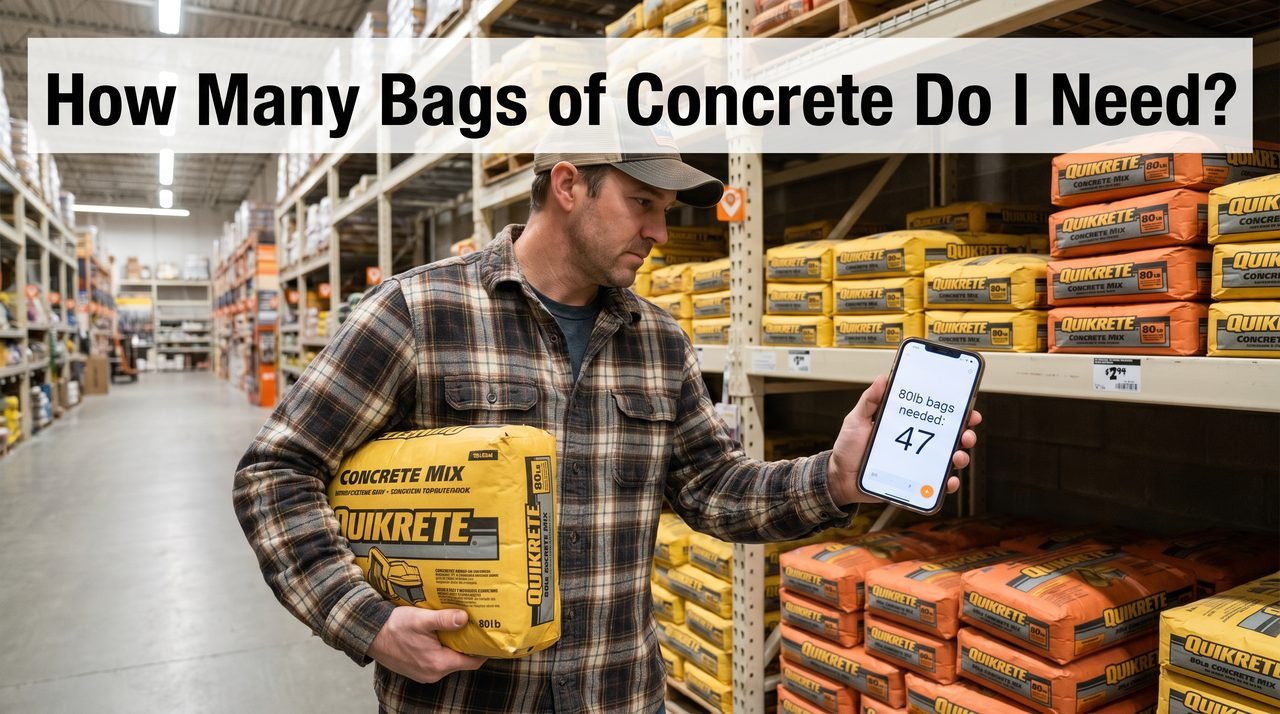
Bags of Concrete Calculator
Bags Needed by Size
| Bag Size | Yield | Bags/yd³ | Approx. Price | Best For |
|---|---|---|---|---|
| 40 lb | 0.30 ft³ | 90 bags | ~$4.50 | Small patches, limited mobility |
| 60 lb | 0.45 ft³ | 60 bags | ~$4.58 | Solo work, walkways, fence posts |
| 80 lb | 0.60 ft³ | 45 bags | ~$6.47 | Slabs, driveways -- best value |
80 lb bags give the best value per cubic foot but require two hands and a strong back. 60 lb bags are the best balance of cost and manageability -- one person can handle them comfortably all day. 40 lb bags are best for tight spaces, seniors, or anyone with back limitations. For large projects, 80 lb bags mean fewer trips and less mixing time.
Quikrete is the most widely available concrete bag brand in North America and offers the broadest product line -- standard, fast-setting, high-strength, crack-resistant, and fiber-reinforced formulas. Sakrete is a comparable quality product common in the eastern U.S. Store-brand bags from Home Depot or Lowes are typically the same quality at a lower price. All produce a nominal 3000-4000 PSI mix.
How Many Bags of Concrete Do Common Projects Need?
A single fence post takes 3 bags of 80lb concrete, a 3x3 ft AC pad takes 6, and a 10x12 ft patio at 4 inches takes 74 -- all counts include a 10% waste buffer.
Buying and Storing Concrete Bags
An 80lb bag yields approximately 0.60 cubic feet of mixed concrete. A 60lb bag yields 0.45 cubic feet. A 40lb bag yields 0.30 cubic feet. These numbers are printed on every bag -- always verify before purchasing because manufacturers vary slightly. When buying in quantity, ask for bags from the same production run to avoid color variation in the finished surface.
Store bags flat in a dry location off the ground. Concrete absorbs moisture through paper -- bags stored on concrete floors or in humid conditions can partially set inside the bag within days. Always inspect bags for hard lumps before mixing. Return lumpy bags for fresh product -- they produce weak concrete with poor workability.
Material Delivery Guide
Home Depot and Lowe’s deliver bagged concrete for $79-$99 per order, while ready-mix trucks charge $75-$150 delivery plus the per-yard concrete price.
| 2026 Truck | Max Payload | Concrete Capacity | Bag Capacity (80lb) |
|---|---|---|---|
| Toyota Tacoma (standard) | 1,521 lbs | ~0.38 cu yd | ~18 bags |
| Toyota Tacoma (i-FORCE MAX) | 1,705 lbs | ~0.42 cu yd | ~21 bags |
| Ford F-150 (PowerBoost Hybrid) | 1,740 lbs | ~0.43 cu yd | ~21 bags |
| Ford F-150 (5.0L V8) | 2,235 lbs | ~0.55 cu yd | ~27 bags |
| Ford F-150 (3.5L EcoBoost) | 2,440 lbs | ~0.61 cu yd | ~30 bags |
| 3/4-ton (F-250, Silverado 2500) | 3,500+ lbs | ~0.87 cu yd | ~43 bags |
*Payload values from 2026 manufacturer specs. Your actual payload is on the door-jamb sticker. Add accessories (toolbox, bedliner) and that number drops 100-300 lbs. A driver and passenger count against payload too.
If your project needs more than 1 cubic yard (4,000 lbs), pickup-truck delivery requires multiple trips. For 2+ cubic yards, ready-mix delivery is almost always cheaper than the gas, time, and suspension wear of multiple bag runs. Most ready-mix trucks deliver 8-10 yards in one trip.
1:2:4 Mix Ratio -- Bag Equivalent
When working from a mix ratio recipe instead of pre-mixed bags, here is what one cubic yard of 1:2:4 mix (2500 PSI) requires in raw materials:
- Portland cement: 6 bags (94 lbs each) -- about 564 lbs total
- Sand: 1,170 lbs -- about 0.6 cubic yards
- Gravel/aggregate: 1,740 lbs -- about 0.9 cubic yards
- Water: 28-32 gallons (0.5 water-cement ratio by weight)
This produces approximately 1 cubic yard of finished 2500 PSI concrete suitable for footings and foundation walls. For a stronger 1:2:3 mix (3000 PSI), use 7 bags of cement instead of 6. Use our Concrete Mix Ratio Calculator for exact quantities of any volume.
Quick Reference: Bag Count by Square Footage
Calculations below assume a standard 4-inch slab depth and include a 10% waste buffer.
| Slab Size (ft) | Total Area | Cu Yards (w/ 10% waste) | 80lb Bags | 60lb Bags |
|---|---|---|---|---|
| 4′ × 4′ | 16 sq ft | 0.22 cu yd | 10 bags | 13 bags |
| 10′ × 10′ | 100 sq ft | 1.36 cu yd | 61 bags | 82 bags |
| 12′ × 12′ | 144 sq ft | 1.96 cu yd | 88 bags | 117 bags |
| 20′ × 20′ | 400 sq ft | 5.43 cu yd | 245 bags | 326 bags |
Standard Concrete Volume Formulas
Cubic Yards Formula: (Length ft × Width ft × Depth ft) ÷ 27 = Cubic Yards
Pre-Mix Bag Yields:
- One 80lb bag yields 0.60 cubic feet (45 bags = 1 cubic yard)
- One 60lb bag yields 0.45 cubic feet (60 bags = 1 cubic yard)
- One 40lb bag yields 0.30 cubic feet (90 bags = 1 cubic yard)
Concrete Bags FAQ
What size bag of concrete should I buy?+
80lb bags give the best cost per cubic foot and are the most common choice. 60lb bags are easier for one person to handle all day. 40lb bags work best for small repairs and limited-mobility situations.
Is bagged concrete cheaper than ready-mix?+
For pours under 1 cubic yard, bagged concrete is usually cheaper because you avoid delivery and short-load fees. Over 2-3 yards, ready-mix almost always wins on total cost.
Can I mix concrete bags by hand?+
Yes for small batches. Use a hoe in a wheelbarrow or trough. For more than 10 bags, a drill with a mortar paddle attachment saves considerable effort. For 20+ bags, rent a barrel mixer.
How long does bagged concrete take to set?+
Standard bagged concrete sets firm in 24-48 hours and reaches full cure strength at 28 days. Quikrete Fast-Setting Concrete sets in 20-40 minutes -- ideal for fence posts using the dry-pour method.
Affiliate Disclosure: As an Amazon Associate, this site earns from qualifying purchases. Links on this page may earn a small commission at no extra cost to you.
Recommended Jobsite Tools
-
Leveling & Screeding
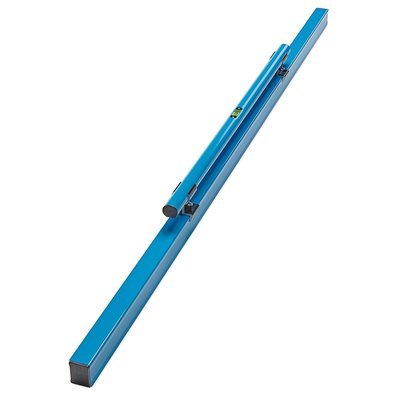
Aluminum screed board strikes off excess concrete level with your forms. Essential for smooth, even slabs.
Check Aluminum Screed Boards on Amazon → -
Hand Finishing
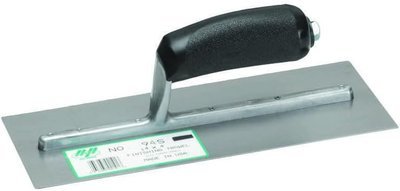
High-carbon steel trowel produces a hard, smooth finish once bleed water evaporates. Standard tool for every pour.
Check Concrete Trowels on Amazon → -
Knee Protection
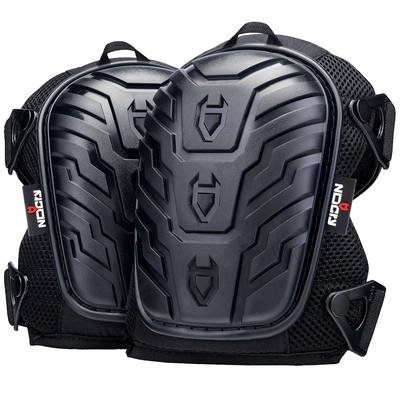
Heavy-duty gel knee pads protect your joints during long finishing hours on wet concrete and kneeling work.
Check NoCry Knee Pads on Amazon → -
Eye & Face Safety
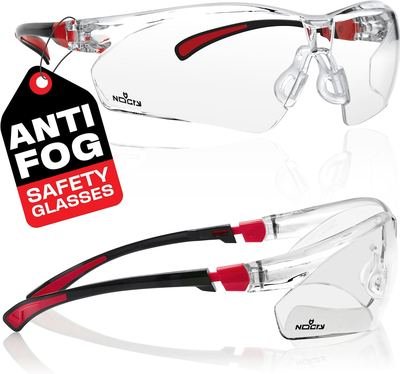
ANSI Z87.1 approved safety glasses block alkaline wet concrete splashes before they reach your eyes.
Check NoCry Safety Glasses on Amazon →