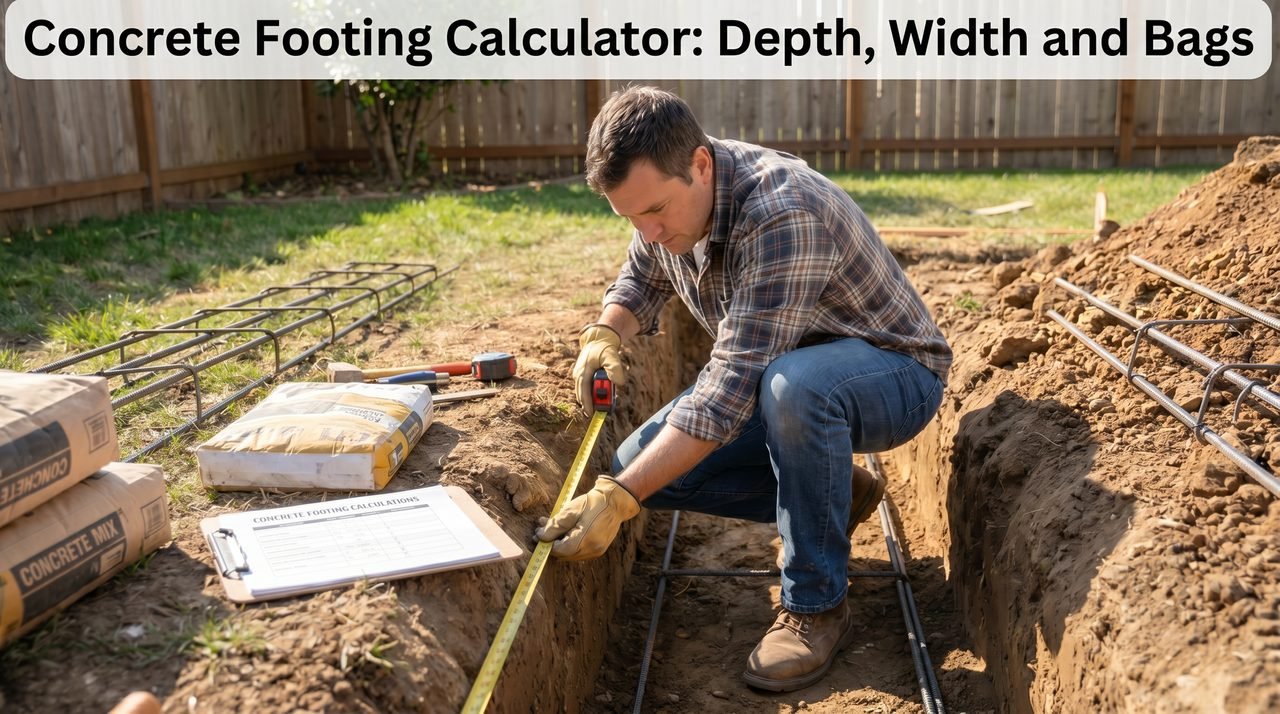
Footing Depth by Project Type
| Application | Min Thickness | Recommended | Reinforcement |
|---|---|---|---|
| Sidewalk / Walkway | 3.5" | 4" | Optional fiber |
| Patio | 4" | 4" | Mesh recommended |
| Residential Driveway | 4" | 5" | Mesh or rebar grid |
| Garage Floor | 4" | 5-6" | Rebar grid required |
| RV/Truck Pad | 6" | 6-8" | Heavy rebar grid |
| Shed Foundation (small) | 4" | 4" | Mesh |
| Pool Deck | 4" | 4-5" | Mesh + control joints |
| Hot Tub Pad | 4" | 6" | Rebar grid |
For freeze-thaw climates (Northeast, Midwest, Mountain West), add 1 inch to the recommended thickness. Always check your local building code -- some jurisdictions require 6" minimum for driveways regardless of use.
Footing Pour Checklist
- Excavate to depth. Slab thickness + base depth + 2" for forms = total dig depth. For a 4" slab on 4" base, dig 10" below final grade.
- Compact subgrade. Native soil should be compacted to 95% before adding base. Don't skip this on clay or recently disturbed soil.
- Lay 4" of crushed stone or roadbase. Compact in 2" lifts. 95% compaction is the target.
- Set forms. 2x4 lumber for 3.5" slabs, 2x6 for 5" slabs. Stake every 4 feet. Check for level and proper slope (¼" per foot away from buildings).
- Place vapor barrier and reinforcement. 6 mil poly under interior slabs. Wire mesh or rebar grid raised 1.5-2" off the base on chairs.
- Pour and screed. Pour from far end working back. Screed level with the forms using a 2x4. Don't over-work the surface.
- Float, edge, and joint. Bull float once water sheen disappears. Edge the perimeter with an edging tool. Cut control joints every 8-10 feet.
- Final finish and cure. Broom finish for traction or trowel for smooth. Cover with plastic for 7 days minimum, lightly mist daily.
- Wait before loading. Foot traffic 24-48 hours. Vehicles 7 days. Heavy equipment 28 days.
Footing Size Quick Reference -- Bags per Footing
| Footing Type | Dimensions | Cu Ft Each | 80lb Bags Each | Common Use |
|---|---|---|---|---|
| Sonotube 8" × 24" | 8in dia, 24in deep | 0.70 | 2 bags | Light deck posts |
| Sonotube 10" × 36" | 10in dia, 36in deep | 1.64 | 3 bags | Standard deck, pergola |
| Sonotube 12" × 36" | 12in dia, 36in deep | 2.36 | 4 bags | Deck, porch, heavy post |
| Sonotube 16" × 48" | 16in dia, 48in deep | 5.59 | 10 bags | Heavy beam, large deck |
| Pad footing 2×2×12" | 2ft × 2ft × 12in | 4.00 | 7 bags | Column base, post pad |
| Pad footing 3×3×12" | 3ft × 3ft × 12in | 9.00 | 17 bags | Heavy column, support beam |
| Strip footing 16"×8" × 30ft | 16in wide, 8in deep, 30ft | 26.67 | ready-mix | Foundation wall, retaining wall |
Footing Depth by Climate -- Frost Line Guide
Step-by-Step: How to Pour a Concrete Footing
- Check your local frost depth. Your footing must go below this depth or freeze-thaw cycles will heave it out of the ground. In Alabama: 6 inches. In Tennessee: 12 inches. In Ohio: 32 inches. In Minnesota: 60 inches. Call your local building department to confirm.
- Call 811 before digging. This is the national "call before you dig" number. Free service. They mark underground utilities within 3 business days. Skipping this step can result in serious injury and large fines.
- Dig to below frost depth plus 6 inches. The extra 6 inches becomes your footing base below the column. Compact the bottom of the hole with a hand tamper or 2×4 before pouring.
- Set your Sonotube form. Cut it to height, check it is plumb and at the correct elevation. Stake the outside if the tube is in a hole wider than the tube diameter. Some contractors use gravel at the bottom for drainage.
- Mix and pour in one continuous operation. Do not stop mid-pour -- it creates a cold joint. For 3-5 bags, use an electric mixer. Wear gloves and eye protection -- wet concrete is caustic and will burn bare skin on contact.
- Set your anchor hardware immediately. J-bolts, post bases, or rebar stubs must be set before the concrete stiffens. Check alignment and position while the concrete is still workable. You have about 30-45 minutes depending on temperature.
Footing Pour: Truck Delivery Guide
| 2026 Truck | Max Payload | Concrete Capacity | Bag Capacity (80lb) |
|---|---|---|---|
| Toyota Tacoma (standard) | 1,521 lbs | ~0.38 cu yd | ~18 bags |
| Toyota Tacoma (i-FORCE MAX) | 1,705 lbs | ~0.42 cu yd | ~21 bags |
| Ford F-150 (PowerBoost Hybrid) | 1,740 lbs | ~0.43 cu yd | ~21 bags |
| Ford F-150 (5.0L V8) | 2,235 lbs | ~0.55 cu yd | ~27 bags |
| Ford F-150 (3.5L EcoBoost) | 2,440 lbs | ~0.61 cu yd | ~30 bags |
| 3/4-ton (F-250, Silverado 2500) | 3,500+ lbs | ~0.87 cu yd | ~43 bags |
*Payload values from 2026 manufacturer specs. Your actual payload is on the door-jamb sticker. Add accessories (toolbox, bedliner) and that number drops 100-300 lbs. A driver and passenger count against payload too.
If your project needs more than 1 cubic yard (4,000 lbs), pickup-truck delivery requires multiple trips. For 2+ cubic yards, ready-mix delivery is almost always cheaper than the gas, time, and suspension wear of multiple bag runs. Most ready-mix trucks deliver 8-10 yards in one trip.
Concrete Footing FAQ
How much concrete do I need for footings?+
For round sonotube footings, use π × radius² × depth. A 12-inch diameter sonotube at 36 inches deep = 3.14 × 0.5² × 3 = 2.36 cubic feet per footing, or 4 bags of 80lb concrete. For rectangular footings, multiply length × width × depth (in feet) to get cubic feet, then divide by 0.60 for 80lb bag count.
What is the difference between a footing and a footer?+
Footing and footer mean the same thing -- both refer to the concrete base that supports a structure. The correct technical term is 'footing', but 'footer' is widely used in construction trades and means identical work. Your local building inspector will accept either term.
How deep do concrete footings need to be?+
Footings must extend below the local frost line to prevent freeze-thaw heaving. In warm climates (Florida, Texas, Arizona), 12-18 inches is typical. Moderate climates (Virginia, Tennessee, Kentucky) require 18-24 inches. Cold climates (Minnesota, Wisconsin, New York) require 36-60 inches. Always check your local building code -- frost depth requirements vary by county.
How many bags of concrete for a sonotube footing?+
A 12-inch sonotube at 36 inches deep requires about 4 bags of 80lb concrete per footing. An 8-inch tube at 24 inches needs 2 bags. A 16-inch tube at 48 inches needs 10 bags. Use our calculator above to get the exact count for your dimensions.
What size footing do I need for a deck post?+
Most residential deck posts require a 12-inch diameter sonotube at the local frost depth (minimum 36 inches in cold climates). Heavily loaded beams or posts carrying more than 2,000 lbs may require a 16-inch tube or a pad footing. Check your deck's span tables and local code for exact requirements.
Can I use Quikrete fast-setting concrete for footings?+
Yes -- Quikrete Fast-Setting Concrete (#1004) is commonly used for fence posts and light deck footings. Pour it dry into the hole, add water, and it sets in 20-40 minutes. Do not use fast-setting concrete for structural footings supporting heavy loads -- use standard 3,000 or 4,000 PSI mix instead.
Affiliate Disclosure: As an Amazon Associate, this site earns from qualifying purchases. Links on this page may earn a small commission at no extra cost to you.
Recommended Jobsite Tools
-
Leveling & Screeding
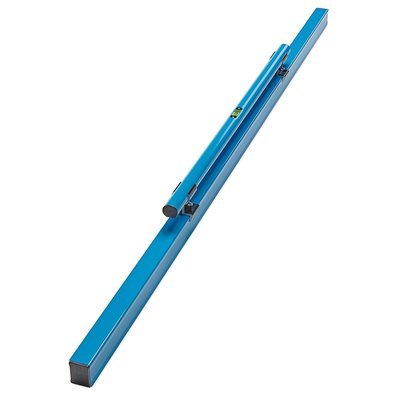
Aluminum screed board strikes off excess concrete level with your forms. Essential for smooth, even slabs.
Check Aluminum Screed Boards on Amazon → -
Hand Finishing
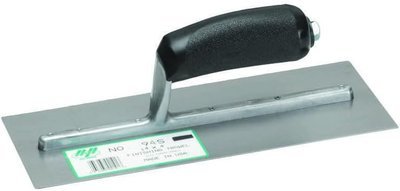
High-carbon steel trowel produces a hard, smooth finish once bleed water evaporates. Standard tool for every pour.
Check Concrete Trowels on Amazon → -
Knee Protection
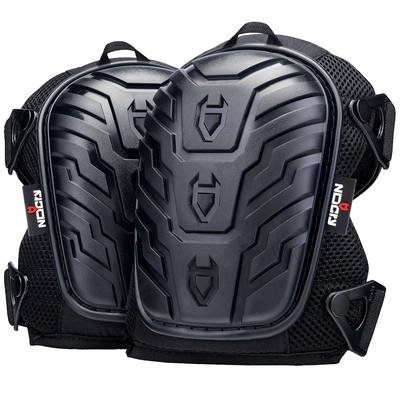
Heavy-duty gel knee pads protect your joints during long finishing hours on wet concrete and kneeling work.
Check NoCry Knee Pads on Amazon → -
Eye & Face Safety

ANSI Z87.1 approved safety glasses block alkaline wet concrete splashes before they reach your eyes.
Check NoCry Safety Glasses on Amazon →